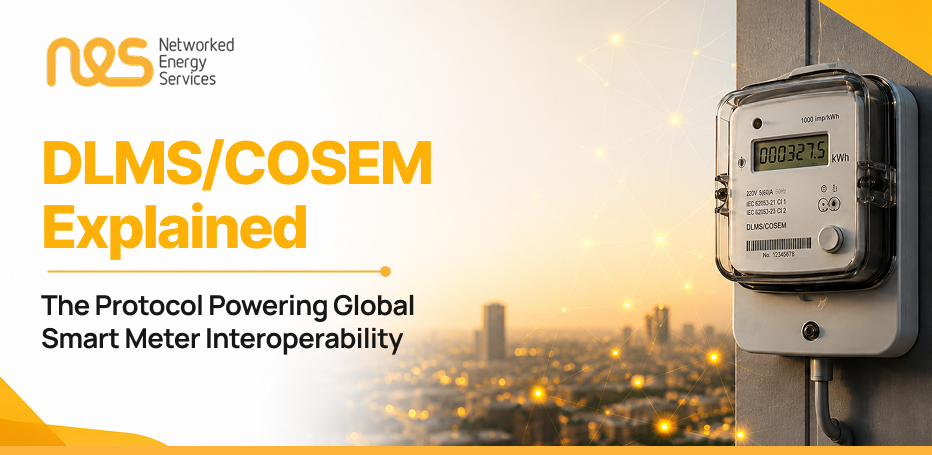
DLMS COSEM Explained The Protocol Powering Global Smart Meter Interoperability
Every time a utility remotely reads a meter, tops up a prepaid balance, or remotely disconnects a defaulting customer, there is a quiet piece of engineering making that possible in the background. It isn't the meter hardware, and it isn't the head-end software alone — it's the language the two speak to each other. That language, for the vast majority of the world's electricity, water and gas meters outside North America, is DLMS/COSEM.
If you've ever typed "what is DLMS protocol" into a search bar because a vendor spec sheet mentioned it, or you're evaluating a DLMS HES integration company in India for your utility's AMI rollout, this guide will take you from the basics to the level of detail you need to make informed procurement and engineering decisions.
What Is DLMS Protocol?
DLMS stands for Device Language Message Specification. In plain terms, it is a communication protocol that defines how data moves between a smart meter and the systems that need to read it — typically a Head-End System (HES) at a utility's data center. But DLMS on its own is only half the story. It tells you how messages are structured and transmitted; it doesn't tell you what data lives inside a meter or how that data is organized. That's where COSEM comes in.
What Is COSEM?
COSEM stands for Companion Specification for Energy Metering. It defines the data model — an object-oriented way of describing everything a meter measures and does: energy registers, load profiles, tariff structures, billing periods, event logs, and (critically for prepaid systems) credit balances and disconnect/reconnect switches. Put together, a DLMS meter is one that packages its internal data as COSEM objects and transports that data using the DLMS protocol. This is why in the industry the two terms are almost always used as a single phrase: DLMS COSEM, or sometimes written as DLMS/COSEM protocol.
DLMS vs COSEM Difference — A Simple Way to Remember It
The DLMS vs COSEM difference trips up a lot of people new to smart metering, so here's the cleanest way to think about it:
- DLMS = the delivery truck. It handles how data is packaged, encoded, secured, and physically moved between the meter and the HES — over cellular, RF mesh, PLC, or any other communication media.
- COSEM = the inventory list inside the truck. It defines what each item is, how it's labeled, and what it means — voltage readings, active energy, tariff registers, prepayment credit, and so on.
You cannot have meaningful communication with just one. DLMS without COSEM would be a truck with no manifest — you could move data, but nobody would agree on what it means. COSEM without DLMS would be a perfectly organized warehouse with no delivery mechanism. Together, they form a complete, vendor-neutral language that any compliant meter and any compliant HES can use to talk to each other — regardless of who manufactured either one.
IEC 62056 Standard Explained
DLMS/COSEM isn't a proprietary invention of a single vendor — it's an internationally recognized standard, formally published as IEC 62056 by the International Electrotechnical Commission, and maintained by the DLMS User Association (DLMS UA). To understand the IEC 62056 standard explained in practical terms, it helps to know it's built from four foundational reference documents, informally called the "books":
- Green Book — defines the COSEM object model and identification system (how meter data is structured and named)
- Yellow Book — defines DLMS/COSEM architecture and communication profiles across different transport media
- Blue Book — defines the COSEM interface classes and OBIS object identification system in full technical detail
- White Book — defines terminology and glossary so vendors, integrators and utilities share a common technical vocabulary
A product that conforms to the Yellow Book specification is considered IEC 62056 compliant.
OBIS Codes Explained: How Smart Meters Name Their Data
Inside every COSEM object is a unique identifier called an OBIS code — Object Identification System. If COSEM defines what kind of data a meter holds, OBIS is the specific "address" for each individual data point. To understand OBIS codes explained simply: imagine a spreadsheet with thousands of possible rows a meter could report — total active energy imported, total active energy exported, instantaneous voltage on phase A, cumulative reactive energy, current tariff rate, remaining prepaid credit. Each of these gets a standardized, six-group numeric code (for example, structured as A-B:C.D.E*F) so that any DLMS-compliant HES anywhere in the world can request "1.8.0" and know, unambiguously, that it's asking for total active energy imported — regardless of the meter manufacturer or country of deployment. This standardization is precisely why a utility in Germany, a DISCOM in India, and a utility in Nigeria can all use the same core integration logic even though they're sourcing meters from entirely different vendors.
How DLMS/COSEM Actually Moves Data: GET, SET, and ACTION
DLMS/COSEM uses a client-server model. The meter is the server — it holds the data. The Head-End System is the client — it requests and, where authorized, modifies that data. Three core services handle almost everything:
- GET — the HES requests to read a value from a COSEM object (e.g., current energy consumption)
- SET — the HES writes or updates a value (e.g., updating a tariff table)
- ACTION — the HES triggers a method on the meter (e.g., issuing a remote disconnect command)
These three services, applied consistently across thousands of standardized OBIS-identified objects, are what let a single HES platform manage millions of meters — including billing, load profile collection, tamper alerts, outage detection, and remote connect/disconnect — without needing meter-specific custom code for every device on the network.
DLMS/COSEM and Prepaid Smart Metering
This is where the protocol becomes directly relevant to one of the fastest-growing segments in the industry: prepaid smart meters.A prepaid smart meter (also called a pre pay smart meter or smart prepay meter) allows a customer to load credit in advance and consume electricity against that balance — similar to a mobile phone recharge. When the balance runs low, the meter can issue a warning; when it hits zero, it can automatically disconnect supply, and reconnect the moment new credit is loaded, all without a truck roll.
None of this is possible without DLMS/COSEM's structured object model. Specific COSEM objects handle:
- Credit and balance tracking — the remaining prepaid amount is stored and updated as a COSEM register object, readable via GET and updatable via SET when a recharge is processed
- Tariff and pricing objects — used to calculate consumption cost in real time against the loaded credit, supporting time-of-day or slab-based prepaid tariffs
- Disconnect/reconnect control objects — triggered via the ACTION service, allowing the utility (or the meter itself, based on pre-configured thresholds) to cut or restore supply remotely
- Event and alarm logs — recording low-balance warnings, tamper attempts, and disconnect/reconnect events for audit and dispute resolution
This is why a pay as you go smart meter deployment is fundamentally a DLMS/COSEM integration project as much as it is a hardware rollout. Utilities in India (under RDSS), across parts of Africa, and increasingly in the UK and MENA are standardizing on DLMS meter infrastructure specifically because it gives them a vendor-agnostic way to run prepaid programs at scale — switching meter manufacturers over time without rebuilding their entire billing and revenue protection stack. For utilities and DISCOMs evaluating a shift toward pay-as-you-go models, the real complexity isn't the meter itself — it's ensuring the HES, MDMS, and billing systems correctly interpret and act on these prepaid-specific COSEM objects across every vendor's meter on the network. Poorly implemented prepaid logic is one of the most common causes of billing disputes and revenue leakage in AMI programs.
Why Utilities Choose DLMS/COSEM Over Proprietary Protocols
Before DLMS/COSEM gained global traction, many utilities relied on proprietary, vendor-specific communication formats, or regional standards such as ANSI C12.19 (still dominant in parts of North America). These worked, but locked utilities into a single vendor's ecosystem — replacing or adding a second meter manufacturer meant rebuilding integration logic from scratch.
DLMS/COSEM changes that equation in three concrete ways:
- Multivendor interoperability — a utility can run a mixed-vendor meter fleet against a single HES platform, avoiding lock-in and enabling competitive procurement
- Media independence — the same COSEM object model works whether the meter communicates over RF mesh, cellular, PLC, or fiber, which matters enormously as utilities migrate from PLC/RF toward cellular for faster, more reliable reads
- Future-proofing — because new COSEM interface classes can be added without breaking the existing application layer, utilities can extend functionality (like new prepaid features or demand-response controls) without a forklift upgrade of every meter and every integration point
This is a major reason global AMI investment continues to favor DLMS-compliant infrastructure, particularly across Europe (where regulatory mandates increasingly require standards-based interoperability), India's large-scale RDSS smart metering program, and fast-growing MENA and African utility markets building next-generation grids largely on modern, cellular-first, DLMS-based architectures rather than legacy proprietary systems.
DLMS/COSEM Around the World: Regional Adoption Patterns
While DLMS/COSEM is a global standard, how it gets deployed varies meaningfully by region — and understanding these patterns matters for anyone benchmarking a rollout or evaluating vendors.
India. India's Revamped Distribution Sector Scheme (RDSS) has made DLMS-compliant smart meters the de facto standard for the country's massive AMI rollout, targeting hundreds of millions of consumer and feeder meters. Given the scale and multivendor procurement model most DISCOMs follow, DLMS/COSEM's interoperability isn't a nice-to-have here — it's the only practical way to run a national program across dozens of meter manufacturers and system integrators simultaneously. Prepaid and pay-as-you-go functionality is also gaining traction in Indian urban and semi-urban deployments as DISCOMs look to reduce collection costs and improve cash flow.
United Kingdom and Europe. The UK's smart metering program (SMETS-based) and the EU's Energy Efficiency Directive, which pushes member states toward high smart-meter penetration targets, both lean on standards-based, interoperable metering architecture. European utilities in particular value DLMS/COSEM's vendor neutrality because procurement regulations often require competitive, multi-supplier tendering — something proprietary protocols make difficult to achieve cleanly.
MENA. Utilities across the Gulf and wider MENA region are building much of their metering infrastructure without the burden of large legacy proprietary meter fleets, which means many are standardizing on modern, cellular-first DLMS/COSEM architecture from day one rather than migrating an older system. This "leapfrogging" pattern is one reason the region is seeing some of the fastest AMI growth rates globally.
North America. This is the notable exception — ANSI C12.19 remains dominant across much of the US and Canada, largely for historical reasons tied to early utility procurement decisions. That said, some North American utilities and system integrators working on international projects, or evaluating next-generation platforms, are increasingly DLMS/COSEM-literate, since global meter manufacturers build to the standard by default.
DLMS vs COSEM vs OBIS: A Quick Reference
Because these three terms get used almost interchangeably in casual conversation, here's a simple reference table to keep them straight:
Term | What It Actually Defines | Analogy |
|---|---|---|
DLMS | How data is transported, encoded and secured between meter and HES | The delivery mechanism |
COSEM | The data model — what objects exist and what they represent | The inventory system |
OBIS | The unique identifier/address for each individual data object | The item's barcode |
IEC 62056 | The formal international standard that codifies all three | The rulebook everyone agrees to follow |
Understanding this distinction is genuinely useful in vendor conversations — when an RFP or a meter datasheet says "DLMS/COSEM compliant," it's really making three separate claims at once: the transport layer is standards-based, the data model is standards-based, and the object naming is standards-based. A meter can technically claim partial compliance in ways that create integration friction later, which is exactly why conformance testing matters before large-scale procurement decisions are finalized.
Common Implementation Challenges
DLMS/COSEM is a mature, well-documented standard — but "standard-compliant" and "interoperable in practice" are not always the same thing. Utilities and system integrators commonly run into:
- Companion specification drift — different meter manufacturers sometimes implement optional COSEM object variations slightly differently, requiring careful conformance testing before go-live
- Security profile mismatches — DLMS/COSEM supports multiple authentication and encryption levels (from low-level security to high-level security with dedicated keys); mismatched security configuration between meter and HES is one of the most frequent field integration failures
- Prepaid logic edge cases — synchronizing credit balances, handling partial recharges, and correctly logging disconnect events across firmware versions from different vendors requires rigorous testing, not just protocol compliance on paper
- Scale and performance — a HES designed for a pilot of a few thousand meters can behave very differently when scaled to millions of DLMS meters polling on staggered schedules; architecture decisions made early often determine whether a national rollout stays on budget
This is precisely why utilities and DISCOMs increasingly look for a specialized DLMS HES integration company in India rather than attempting DLMS/COSEM integration purely in-house or relying solely on a single meter vendor's proprietary tooling — the protocol knowledge required spans metering domain expertise, secure systems engineering, and large-scale distributed systems architecture simultaneously.
How NES Technology Approaches DLMS/COSEM Integration
NES Technology has spent over two decades working at the intersection of energy domain expertise and software engineering, and DLMS/COSEM sits at the core of that experience. Our Grid Operations platform is built around a unified DLMS Head-End System supporting cellular, RF, and PLC communication simultaneously — allowing utilities to run a single HES against a genuinely mixed-vendor meter fleet rather than maintaining separate integration stacks per manufacturer.
For utilities specifically pursuing prepaid or pay-as-you-go programs, our teams work directly with the prepaid-specific COSEM object sets — credit management, tariff synchronization, and remote disconnect/reconnect logic — to reduce the billing disputes and revenue leakage that poorly tested prepaid integrations commonly cause. Combined with Grid X, our AMI data analytics layer, utilities gain not just protocol-compliant connectivity but usable intelligence: loss detection, consumption anomalies, and renewable impact insights built on top of the same standardized DLMS/COSEM data model.
Whether you're a DISCOM planning a large-scale smart metering rollout, a system integrator needing a reliable DLMS HES partner, or a utility evaluating a shift to prepaid metering, working with a team that understands both the protocol-level detail and the operational realities of scaling across millions of meters materially reduces integration risk.
Frequently Asked Questions
What is DLMS protocol used for? DLMS protocol is used to enable standardized, secure communication between smart meters and head-end systems, supporting remote meter reading, billing, tariff management, and control functions like remote disconnect/reconnect.
Is DLMS/COSEM the same as IEC 62056? Yes. IEC 62056 is the formal international standard published by the IEC, based on the DLMS UA's specification documents (the Green, Yellow, Blue and White Books) that define DLMS/COSEM.
Can DLMS/COSEM support prepaid smart meters? Yes. Prepaid and pay-as-you-go smart metering relies on specific COSEM objects for credit balance tracking, tariff calculation, and remote disconnect/reconnect — all accessed through the standard DLMS GET, SET, and ACTION services.
Does DLMS/COSEM work across different meter manufacturers? That's its core purpose. As a vendor-neutral, internationally standardized protocol, DLMS/COSEM allows utilities to integrate meters from multiple manufacturers against a single head-end system, provided all devices are compliant with the same conformance level.
Final Thoughts
DLMS/COSEM isn't the most visible part of a smart grid — nobody sees it the way they see a meter on a wall or a mobile recharge notification. But it's the layer that makes modern metering programs actually work at scale: multivendor interoperability, standardized prepaid functionality, and a foundation flexible enough to support whatever the next generation of grid intelligence requires.
For utilities and DISCOMs evaluating their next AMI phase — whether that's a first-time prepaid rollout, a multivendor HES consolidation, or a full smart metering program — understanding DLMS/COSEM at this level isn't optional. It's the difference between a rollout that scales cleanly and one that accumulates integration debt with every new meter vendor added to the network.
Looking for a DLMS HES integration partner with real-world experience across cellular, RF, and PLC deployments?